Communities of Practice
Opportunities
Create your own COP
Interested in joining a community of practice or forming one with support from the Learning and Teaching Hub? Email us at [email protected].
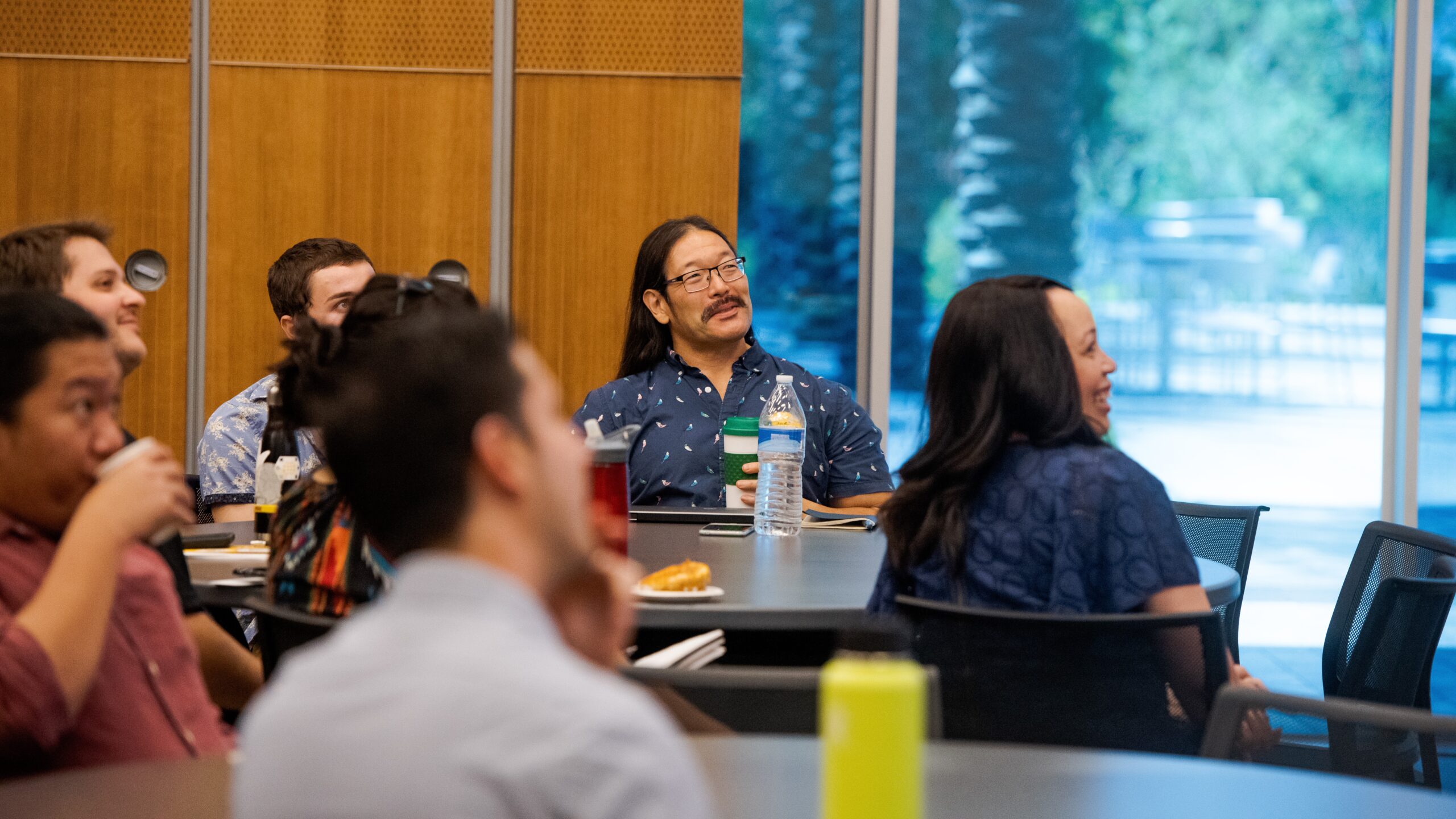
Our communities of practice provide personalized applied learning opportunities related to specific topics. Communities of practice meet virtually every month, with in-person opportunities provided through social and networking events.
Learning Communities
Led by Eric Bishop and Andrew Salcido
In alignment with ASU’s commitment to access and student success, this Community of Practice focuses on the continued implementation and growth of learning communities across a range of instructional formats. Through collaborative partnerships among students, faculty, and staff, the group seeks to address structural barriers, promote equity, and strengthen a shared sense of belonging through intentional course and program design.
Participants will engage with examples of current initiatives, explore lessons learned from recent implementations, and discuss strategies for scaling and sustaining learning communities across disciplines. The session will provide practical tools, frameworks, and adaptable approaches that educators can apply to create inclusive, engaging, and supportive environments for all learners.
Meaningful Learning with Multimedia
Led by Dhruv Bhate and Nick Lindquist
Multimedia has the potential to create meaningful and engaging experiences, but how can we design and deliver content that truly enhances student learning? This Community of Practice explores the development and implementation of multimedia content that supports and complements hands-on learning. Participants will engage in collaborative discussions, share best practices, and explore tools and techniques for multimedia design and integration in engineering courses.
Learning for All: Practices that Support Student Success
Led by Christina Carrasquilla and Stefani Jenkins
This year, we invite Fulton Schools program chairs, academic leaders, and decision makers to join a five-part Community of Practice focused on designing programs that better align with students’ lives.
RSVP is highly recommended, as each session will include program-specific data about your students. Participants will use these insights to identify opportunities, take action, and leave with concrete, actionable takeaways for their own programs.
Together, we will explore a different question: How might our programs be designed to work with students’ lives?
[Workshop #1] Learning for All: Understand the Learner & Industry Context
October 13, 2026 | 12:00-1:00 p.m.
RSVP- Zoom
Who are your students today? What responsibilities do they balance? How do they discover your program? How does industry define relevant roles and skills?
[Workshop #2] Learning for All: Align Academic Identity
November 10, 2026 | 12:00-1:00 p.m.
RSVP- Zoom
Can a prospective student understand your program’s outcomes? Do your degree and course names reflect industry language? Are pathways clear and intuitive?
[Workshop #3] Learning for All: Design for Structured Flexibility
January 12, 2027 | 12:00-1:00 p.m.
RSVP- Zoom
Where does your schedule create friction for students? What assumptions exist about time, availability, and pacing? How predictable is your structure?
[Workshop #4] Learning for All: Align Modality with Purpose
February 9, 2027 | 12:00-1:00 p.m.
RSVP- Zoom
What learning experiences require in-person engagement? What content could be delivered asynchronously? Is modality chosen intentionally or by default?
[Workshop #5] Learning for All: Embed Industry Engagement
April 13, 2027 | 12:00-1:00 p.m.
RSVP- Zoom
Where does industry currently show up? Is engagement episodic or integrated? How aligned are internships and coursework?
Across the series, participants will examine program-level design choices including scheduling, modality, course sequencing, experiential learning, advising structures, and other conditions that affect students’ ability to persist and thrive. Our focus will be practical and scalable: supporting rigorous engineering education while reducing unnecessary barriers to participation and success.
By the end of the series, participants will leave with clearer design principles, shared language, and actionable ideas for creating programs where more students can build strong foundations, engage deeply in engineering learning, and move toward their goals without having to sacrifice the realities of their lives.
Mastery-Based Learning
Led by Keith Hjelmstad and Medha Dalal
Mastery-based learning (MBL) is traditionally viewed as a system wherein students move on to the next topic only upon demonstrating mastery of the previous one, often in an asynchronous format. However, in a university setting with fixed semesters, how can we leverage the benefits of mastery-based learning? Two years ago we launched a faculty Community of Practice focused on MBL to explore how we might apply mastery-based assessment strategies with principles of transparency, and student success. We continue building on that foundation. Faculty will share what they’ve implemented in their courses, reflect on what worked (and what didn’t), and collaboratively address the challenges of putting MBL into practice.
Scalable Classroom Assessments in Large Enrollments (SCALE)
Led by Ryan Meuth and Jon Baek
In large-enrollment courses, it can be a challenge to provide students with the formative feedback and resources they need to succeed in a timely manner.
This community of practice will guide you to build in automation and use AI to provide the feedback you have always wished you could give, but never had the time to. We’ll share strategies for developing scalable assignments and assessments, strategies for grading as scale, and resources for managing the challenges of large courses.
Generative AI in Teaching and Learning
Led by Nadia Kellam, Sue Huffman and Jon Baek
Whether you’re new to AI tools or already experimenting with them, this community of practice is open to all instructors curious about the evolving role of AI in teaching and learning. Together, we’ll explore how to create classroom environments that support ethical, critical, and thoughtful use of generative AI.
Our work will be hands-on and learner-centered: participants will unpack real assignments, map how students might approach them with AI, and develop strategies that integrate AI productively, such as assignments and in-class activities. We’ll highlight tools currently available to ASU students and faculty (e.g., ChatGPT, Gemini, Gemini Notebook, CreateAI Builder) and underscore that genAI does not replace faculty or student expertise–it amplifies it. Through modeling, think-alouds, and intentional design, we will help faculty and students use AI responsibly and creatively, developing not only skills with these tools but the deeper habits of mind required of future engineers, creators, and innovators.
LTH Book Study
Led by Marnie Wong, Medha Dalal and Stefani Jenkins
Expand your teaching toolkit by reading and discussing teaching and learning through our professional book study! Every semester, LTH hosts a 3-session virtual book study with a teaching book-of-choice from the community. Book copies are made available to those interested and through the ASU library.
Cohort of Recently-hired Educators (CORE)
Led by Stefani Jenkins and Jon Baek
Cohort of Recently Hired Educators (CORE) is a hands-on community of practice designed exclusively for new engineering faculty at Arizona State University. CORE offers a dynamic workshop-style environment where participants actively engage in monthly sessions on key topics like active learning strategies, student motivation, and effective assessment techniques. Faculty will leave each session with actionable strategies and ready-to-implement ideas tailored to their classrooms.
CORE meets virtually once a month throughout the academic year.
Explore the 2026-2027 academic calendar flyer for more details.