ICAP Framework

Overview and Introduction: The WHAT and WHO
Engineering educators often seek ways to move beyond lectures and problem demonstrations to ensure students truly understand complex concepts and can apply them in design or analysis. The ICAP Framework — which stands for Interactive, Constructive, Active, and Passive — offers a clear, evidence-based approach to develop lessons and evaluate how deeply students are engaging with course material based on the observable student behaviours. Developed by Michelene Chi and colleagues [1], ICAP distinguishes 4 different levels of student engagement predicting their impact on learning:
- Passive/Attentive engagement means students are receiving information from the instructional materials without overtly doing anything else related to learning. For example, they might be listening, observing a video, or reading but not anything else. This mode is associated with the lowest level of learning.
- Active/Manipulative engagement means students are acting selectively. In other words, some form of overt motoric action is undertaken that selects some content for physical manipulation. For example, selecting parts of what they hear or read for taking verbatim notes, rewinding and rewatching a portion of a video, or highlighting certain text sentences. It is associated with a greater level of learning than Passive engagement.
- Constructive/Generative engagement means that students are generating information that is beyond what they have heard or read such as drawing concepts maps or generating notes in their own words This mode leads to a substantially greater level of learning than Active engagement.
- Interactive/Co-generative engagement means that students in a group are not only individually Constructive, but they build on each other’s contributions. Although group work does not automatically result in Interactive engagement, when co-generation does occur, it is associated with greater learning gains than Constructive engagement alone.
Fig. 1 illustrates the four ICAP modes of student engagement and their predicted impact on the level of learning. In addition, Table 1 provides examples of common learning activities categorized by ICAP mode and instructional modality (verbal, written, and visual).
![Fig. 1. Based on the ICAP framework presented in [1].](https://lth.engineering.asu.edu/wp-content/uploads/2026/02/image.png)
Fig. 1. Based on the ICAP framework presented in [1].
Table I
EXAMPLES OF LEARNING ACTIVITIES BY MODES OF ENGAGEMENT
| Type of Learning Activity (Modality) |  Passive/Attentive |  Active/Manipulative |  Constructive/Generative |  Interactive/Co-generative |
| Verbal(Lecture) | Listening to a lecture without doing anything else | Taking verbatim notes during a lecture or recitation; copying equations, diagrams or solution steps just as the instructor presents them | During a lecture, taking notes in one’s own words; drawing concept maps; asking questions | Debating a solution or design choice in a small group |
| Written (Text) | Reading texts or problem descriptions silently or aloud without engaging in any other activity | Underlining or highlighting texts, formulas while reading; creating summaries that simply copy and delete information rather than reorganizing or explaining it | While reading a text, taking notes in one’s words that make predictions or inferences; integrating information from multiple resources (e.g., combining textbook explanations, simulation outputs, and lab data). | Discussing the content of the text with a partner, where each contribution to the discussion builds on or references earlier contributions. |
| Visual (Video) | Watching a demonstration or instructional video without engaging in any other activity | Manipulating a video by pausing, rewinding, or reviewing segments without generating commentary | Explaining concepts presented in a video; comparing and contrasting such concepts with prior knowledge, previous coursework, or other materials | Peer discussions where students build on each other’s reasoning, and jointly make sense of the content |
Based on the ICAP framework presented in [1].
ICAP provides a practical way to both design new learning activities and redesign existing lectures, labs, or projects, without requiring a full course overhaul.
Faculty can also use ICAP reflectively – after an activity or class session, instructors can ask themselves, “At which engagement level were my students operating?” This simple reflection helps calibrate future lessons and ensure that activities intentionally move students toward deeper, more interactive modes of learning.
Ultimately, integrating ICAP-informed activities supports students in achieving deeper conceptual learning and the ability to transfer knowledge to new contexts – skills vital for solving open-ended problems and communicating technical ideas.

Implementation and Timing: The WHEN, WHERE, and HOW
Implementation and Timing: The WHEN, WHERE, and HOW
The ICAP framework can be implemented by incrementally redesigning familiar classroom activities to promote higher levels of cognitive engagement. This approach involves moving classroom activities along the ICAP continuum from passive to interactive through small, intentional shifts that fit naturally within existing class and lab structures. Table 2 highlights practical examples of Active, Constructive, and Interactive activities that can be integrated into short class or lab segments (5–15 minutes) and adapted for online learning.
Table II
EXAMPLES OF ACTIVE LEARNING ACTIVITIES ACROSS THREE ICAP MODES
| Active / Manipulative | Constructive / Generative | Interactive / Co-generative | |
| In-person | During a lecture, pause to have students solve a brief calculation or label components on a system diagram before revealing the correct solution. | After completing a worked example, ask students to write one sentence explaining why each step was taken or to sketch how they’d modify the design for a new condition. | Pairs exchange solutions to a design or analysis problem, questioning and refining each other’s reasoning before presenting a consensus to the class. |
| Online | Embed a short auto-graded quiz or drag-and-drop labeling activity in a recorded lecture or learning module. | Create and submit a concept map of the unit topics and how they connect to each other, using Word/Powerpoint. | Organize peer review using tools such as FeedbackFruits or Canvas peer assignments, where partners critique and suggest improvements. |
| Quick Implementation Tip | Provide immediate feedback or model reasoning aloud to keep students cognitively engaged | Focus prompts on reasoning (‘Explain why…’) rather than recall (‘What is…’) to push into constructive engagement. | Use clear peer-interaction roles (Explain, Question, Refine), and close with a brief reflection to consolidate learning. |
| Timing | 5-7 min | 7-10 min | 10-15 min |
ICAP Implementation Tips for Faculty
- Use existing course structures. Weekly problem-solving sessions, lab reflections, design reviews, or discussion boards all lend themselves to ICAP-based redesign. As a first step, reflect on how passive, active, constructive, or interactive these activities currently are. Small, targeted changes (e.g., embedding short self-explanation or peer-critique elements) can increase learning depth without adding grading burden.
- Start small and scale strategically. Introduce one ICAP-aligned activity every 1–2 weeks rather than overhauling entire lessons. Begin with Active prompts (e.g., clicker questions, annotated examples), then layer in Constructive reflection tasks, and finally add Interactive peer components later in the term.
- Align ICAP activities with natural course rhythms. Early in the semester, focus on Active and Constructive engagement to reinforce foundational skills; mid- to late-semester design projects or labs are ideal for Interactive activities.
- Plan transitions intentionally. Moving from Active to Constructive engagement requires students to generate something new. Moving to Interactive requires structured peer dialogue or collaboration that builds upon those individual ideas.
- Reflect and adjust pacing. After each activity, briefly evaluate: What level of engagement did my students reach? This ongoing reflection helps maintain momentum and balance across the semester.
As shown in Fig. 2 the instructional shift from Passive or Active engagement toward Constructive engagement is often the most effective improvement instructors can make, especially for concepts that students find difficult to understand.
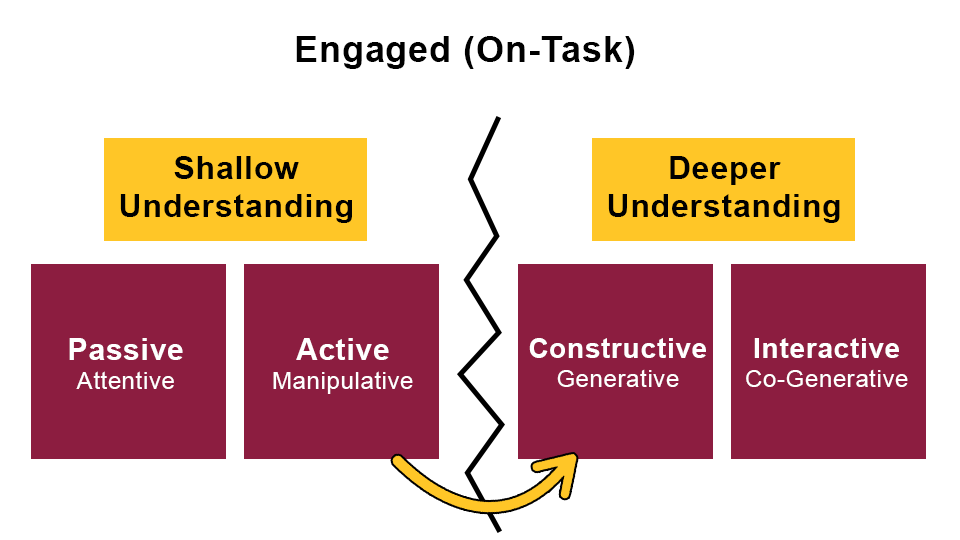
Fig. 2. Shifting Instruction from Passive or Active to Constructive mode of engagement.
Examples of Constructive transitions:
- Revise review questions to require prediction, explanation, synthesis, or analogy.
- Ask students to justify solution steps or write a brief solution plan after solving a problem.
- Use concept maps or diagrams instead of written summaries.
- Provide partially completed solutions or readings for students to complete.
- Ask students to generate questions rather than answer instructor-provided ones.
- Assign problems that require selecting and justifying an approach rather than applying a demonstrated procedure
Examples of Interactive transitions:
- Ask students to explain their solution or reasoning to a peer, then revise their work based on questions or feedback.
- Assign problems that require pairs or small groups to develop a single solution and joint justification, rather than individual submissions.
- Have students compare solution approaches or explanations with peers and agree on a revised or improved version before submission.

Rationale and Research: The WHY
The ICAP framework is grounded in extensive cognitive and educational research demonstrating that learning outcomes improve as student engagement moves from Passive to Active to Constructive to Interactive modes. The original prediction P < A < C ≤ I , reflecting a hierarchical progression of cognitive engagement, is supported by numerous studies. Each successive mode corresponds to increasingly deeper learning outcomes – from minimal or shallow understanding in passive or active engagement to deep and even innovative understanding in constructive and interactive engagement. Since its publication, the ICAP hypothesis has been examined and supported in multiple empirical studies across laboratory and classroom contexts, and the original paper has been cited widely, underscoring the framework’s robustness and influence.
In engineering classrooms, ICAP has been used to analyze and redesign instructional activities ranging from concept-based problem solving to collaborative design projects. For example, Menekse, Stump, Krause, and Chi [2] found that when engineering students engaged in constructive tasks (such as generating explanations or linking concepts), they achieved significantly greater conceptual understanding than peers completing equivalent active tasks. Similarly, interactive peer collaboration – where students explain, question, and respond to one another – has been shown to strengthen both reasoning and retention [3].
These findings align with what many engineering educators observe in practice: students often perform procedures correctly without deeply understanding the ‘why’ behind them. ICAP helps bridge that gap by providing a framework for interpreting how learning activity design relates to cognitive engagement outcomes. Faculty can use ICAP to examine whether an activity truly requires generative thinking (constructive) or shared meaning-making (interactive), which in turn fosters conceptual transfer and innovation – key ABET-aligned outcomes.
ICAP can also inform assessment design by helping instructors align evaluation methods with the depth of engagement they aim to promote. For example, when students engage at a constructive level, formative assessments might focus on written justifications, concept maps, or open-ended reasoning tasks that reveal their thought processes. At the interactive level, peer review rubrics or team-based reflections can serve as both learning and assessment tools. Viewing assessment through the ICAP lens encourages faculty to look beyond correctness alone and to capture how students are thinking, explaining, and building on one another’s ideas.
The ICAP framework also serves as a tool for ongoing reflective teaching practice. By categorizing common instructional strategies (e.g., demonstrations, problem-solving sessions, design critiques) according to ICAP levels, faculty can intentionally balance modes throughout the semester to support deeper, more durable learning.

Additional Resources and References
See the ICAP center’s website for many references, including papers showing how it was used to design lessons: https://icap.education.asu.edu/
For compelling evidence that lecturing is less effective than anything else, see: S. Freeman et al., “Active learning increases student performance in science, engineering, and mathematics,” Proceedings of the National Academy of Sciences, vol. 111, no. 23, pp. 8410-8415, 2014.
Acknowledgments
This guide would not have been possible without the contributions of Dr. Michelene Chi, Regents Professor in Mary Lou Fulton College for Teaching and Learning Innovation at ASU, and Dr. Kurt VanLehn, Emeritus Professor in the School of Computing and Augmented Intelligence at ASU. Dr. Chi’s ICAP theory has significantly shaped contemporary understandings of active learning and instructional design.
References
[1] M. T. H. Chi and R. Wylie, ‘The ICAP Framework: Linking Cognitive Engagement to Active Learning Outcomes,’ Educational Psychologist, vol. 49, no. 4, pp. 219–243, 2014.
[2] D. L. Menekse, G. J. Stump, S. Krause, and M. T. H. Chi, ‘Differentiated Overt Learning Activities for Effective Instruction in Engineering Classrooms,’ Journal of Engineering Education, vol. 102, no. 3, pp. 346–374, 2013.
[3] M. T. H. Chi and D. L. Menekse, ‘Dialogue Patterns in Peer Collaboration Explain Learning Gains,’ Instructional Science, vol. 43, no. 4, pp. 467–491, 2015.
[4] C. J. Boucher and M. T. H. Chi, ‘The ICAP Framework and Instructional Design: Integrating Cognitive Engagement in STEM Classrooms,’ Cognition and Instruction, vol. 38, no. 3, pp. 289–314, 2020.